 Hooked On Belize Sport Fishing
 Zerdz
Zerdz Lost Blue
 Verma Contracting
 Zale's Makeup
 Bud City Dispo
 Beauty By Hammer
 Dash For Devs
 Lost THC (Wholesale)
 Night N Day Detailing
 Lost THC
 BakeBoxx Wholesale
 Surfclub
 FungiReview
 NEST Divers
 Rhone Risk
 BakeBoxx
 RSquare Games
 Sleepless Advertising
Next.js vs React: Key Differences & Best Use Cases
Choosing between Next.js and React depends on your project’s goals, especially when it comes to performance, SEO, and scalability. While React offers flexibility for building dynamic user interfaces, Next.js enhances it with powerful features like server-side rendering and static generation, making it a strong choice for modern, high-performing web applications.
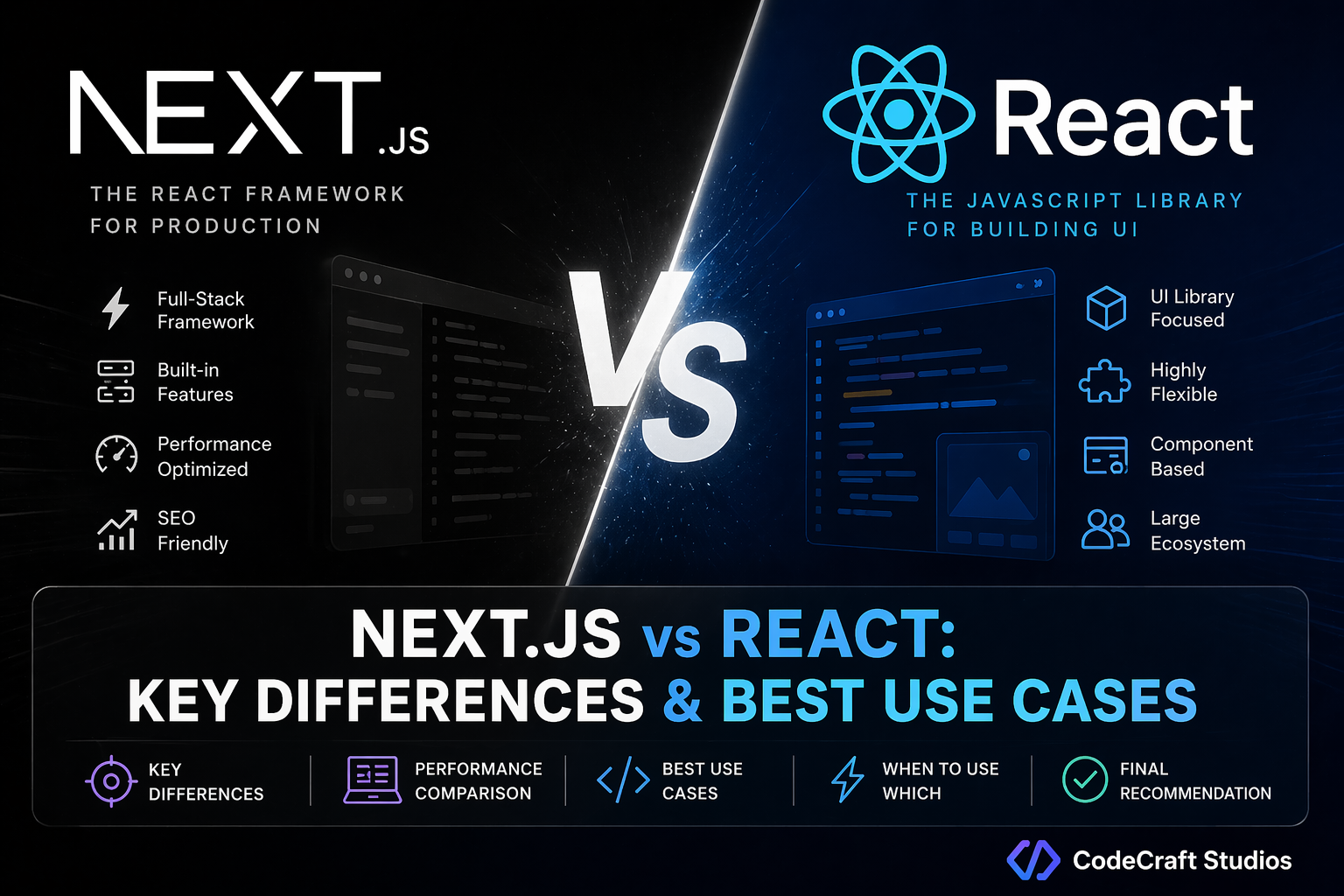
One of the most common questions new developers ask is "should I learn React or Next.js?" — and the question itself reveals the confusion. It's a bit like asking "should I learn engines or cars?" They aren't competing choices. One is built on top of the other. Let's clear it up.
What React Actually Is
React is a UI library. That's it. Created by Facebook (now Meta) in 2013, its only job is to let you build user interfaces out of reusable components and keep them in sync with your data.
React on its own doesn't know:
- How to route between pages
- How to render on a server
- How to fetch data efficiently
- How to optimize images
- How to bundle or deploy your code
To build a real website with pure React, you have to pick and wire up all of those tools yourself.
Example: A Pure React Component
import { useState } from "react";

export default function Counter() {
  const [count, setCount] = useState(0);
  return (
    <div>
      <h1>Count: {count}</h1>
      <button onClick={() => setCount(count + 1)}>+1</button>
    </div>
  );
}
This is React. It's a component. It renders in the browser. There's no page, no route, no server — just UI.
What Next.js Actually Is
Next.js is a framework built on top of React. Created by Vercel in 2016, it takes React and adds all the missing pieces you need to ship a real production website:
- File-based routing
- Server-Side Rendering (SSR) and Static Site Generation (SSG)
- React Server Components
- API routes (backend endpoints in the same project)
- Image, font, and script optimization
- Code splitting and bundle optimization
- Middleware and edge functions
Every Next.js app is a React app. But not every React app is a Next.js app.
Example: The Same Counter in Next.js
// app/counter/page.tsx
"use client";
import { useState } from "react";

export default function CounterPage() {
  const [count, setCount] = useState(0);
  return (
    <div>
      <h1>Count: {count}</h1>
      <button onClick={() => setCount(count + 1)}>+1</button>
    </div>
  );
}
The component code is almost identical. The difference is everything around it: this file automatically becomes the route /counter, it pre-renders on the server for SEO, and the HTML arrives fully formed before JavaScript even loads.
Key Differences at a Glance
- Type: React is a library. Next.js is a framework.
- Routing: React has none built in (you add React Router). Next.js has file-based routing out of the box.
- Rendering: React renders in the browser by default (CSR). Next.js supports SSR, SSG, ISR, and Server Components.
- SEO: React alone is weak for SEO — crawlers see an empty HTML shell until JS runs. Next.js ships fully rendered HTML, perfect for SEO.
- Backend: React has none. Next.js gives you API routes and Server Actions in the same project.
- Setup: React needs Vite/Webpack + Router + bundler + SSR config if you want it. Next.js is all configured.
- Learning curve: React is smaller — just components and hooks. Next.js is React plus routing, rendering strategies, and server concepts.
- Hosting: React apps deploy as static files to any CDN. Next.js in SSR mode needs a Node server or serverless platform.
When to Use React (Alone)
- Single-Page Applications (SPAs) behind a login — dashboards, admin panels, internal tools where SEO doesn't matter
- Embedded widgets that drop into an existing website (a chat bubble, a calculator, a review widget)
- Mobile apps via React Native — same mental model, different platform
- When you want total control over your build pipeline, router, and rendering strategy
- Learning the fundamentals — pure React teaches you what's really happening before a framework hides it
When to Use Next.js
- Marketing sites and landing pages that need SEO
- Ecommerce storefronts — product pages, category pages, blog
- SaaS products with both public marketing pages and authenticated app surfaces
- AI products — OpenAI, Claude, Perplexity, and Cursor all run on Next.js
- Content-heavy apps where you want SSR or ISR for freshness
- Full-stack projects where you don't want a separate backend codebase
Performance: Does Next.js Actually Help?
Yes — significantly, in the scenarios it's designed for. A plain React app makes the browser download JavaScript, execute it, then render the page. That means the user stares at a blank screen until JS finishes. Google's crawler also sees that blank screen on the first pass.
Next.js pre-renders the HTML on the server (or at build time) so the user sees content immediately, and crawlers index it instantly. For anything public-facing, that's not a small advantage — it's the difference between ranking on Google and being invisible.
The Honest Takeaway: Next.js and React
It's not a competition. Next.js is React — plus routing, plus rendering, plus tooling, plus a backend. When you write a Next.js app, every component, every hook, every piece of state management is React. Next.js just handles the 90% of production concerns that React intentionally leaves out.
So the real question isn't "React or Next.js?" — it's "do I need a framework around my React?"
- Building a public website, ecommerce store, SaaS, or anything SEO matters for? Use Next.js.
- Building a widget, an internal tool, or a SPA behind a login? Plain React is fine.
- Learning web development from scratch? Start with React. Once components and hooks click, move to Next.js. You'll appreciate what it does for you because you'll have felt the pain of not having it.
Think of React as the engine and Next.js as the car built around it. You can drive an engine strapped to a go-kart if that's what you need. But if you want to cross the country, you want the whole car.